
JLR TCU Backup Battery Failure: Symptoms & Fix
The Short Answer
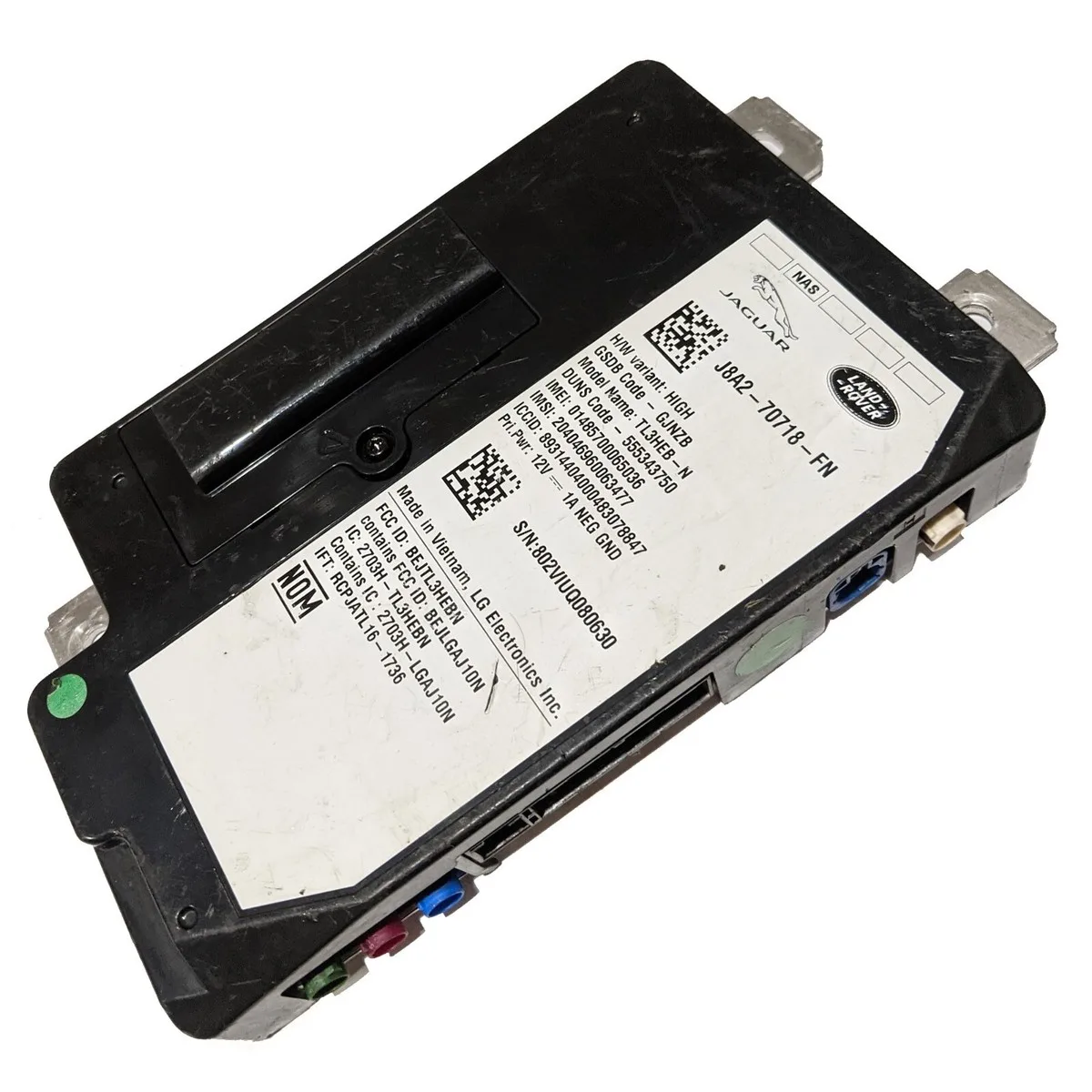
JLR TCU backup battery failure is the most common cause of the "SOS Limited Functionality" warning on 2015–2022 Jaguar Land Rover vehicles. The backup battery is a small rechargeable cell pack inside the Telematics Control Unit that keeps emergency calling alive if the main 12 V supply is lost in a crash. After roughly 5–8 years it no longer holds charge, the TCU's self-test fails, and the warning appears at start-up. The fix is to replace the backup battery (or the TCU containing it) — a repair that costs a fraction of what dealers often quote for a full module.
This guide covers symptoms, why it fails, and the repair options.
What the Backup Battery Does
The TCU backup battery exists for one critical moment: if a collision severs the vehicle's main power, the backup cell keeps the telematics unit alive long enough to place the emergency call — the eCall-style automatic SOS that modern JLR vehicles perform.
Because it is a safety function, the TCU self-tests the backup battery on start-up and reports degradation immediately. That is why the warning feels sudden: the battery declines gradually, but the module announces it the day it crosses the threshold. For background on eCall-type systems, see Wikipedia's eCall article.
Symptoms of a Failing Backup Battery
Backup battery failure has a recognisable signature: a start-up SOS warning that may initially clear after driving, while everything else connected — the app, remote features, tracking — keeps working normally.
Typical pattern:
- "SOS Limited Functionality" message at start-up, sometimes clearing after a drive, later becoming permanent.
- Amber SOS/telephone warning in the cluster or a telematics warning in the infotainment.
- Backup-battery DTCs stored in the TCU on a diagnostic scan.
- In later stages: "SOS System Inactive" and failed over-the-air update behaviour, as the brownouts corrupt TCU operation — a factor in many SOTA lockdown cases.
Notably absent: the InControl app and remote features often keep working fine, which is exactly how you tell this apart from full TCU failure — see signs of a failing JLR TCU.
Why It Fails — and Which Vehicles
The backup battery fails because it is a small rechargeable cell pack cooking in a hot roofline or boot cavity for years — age and heat kill it on a predictable 5–8 year clock, regardless of mileage.
That means the entire 2015–2020 InControl fleet is now in the failure window: Range Rover L405 and Sport L494, Velar, Discovery 5, Evoque, Discovery Sport, and Jaguar XE/XF/F-Pace/E-Pace of the same era. A 2017 Range Rover with its original backup battery in 2026 is living on borrowed time — if yours has not failed yet, budget for it at the next service rather than waiting for the warning.
The Repair Options, Cheapest First
Fix the battery, not the car — the repair starts with an inexpensive cell pack and only escalates if the module itself has suffered damage from leakage or repeated brownouts.
- Backup battery replacement. The correct fix in most cases: access the TCU, swap the cell pack, clear codes, verify the self-test passes. Parts are inexpensive; labour is trim removal. DIY-feasible for careful owners with guidance, trivial for any workshop.
- TCU with battery (used). If the module has suffered from battery leakage or brownout damage, a used TCU with a healthy backup battery, correctly provisioned, is the value route — provisioning is covered in our TCU replacement guide.
- New TCU from dealer. Works, warranty-backed, and usually the most expensive answer to what is often a £30 battery question. Get a second opinion before accepting this quote.
DIY vs Workshop: What Is Realistic?
Backup battery replacement is one of the more accessible JLR repairs — the work is trim removal and a connector swap, with the proviso that access varies by model and the result must be verified with a diagnostic scan.
Honest assessment:
- DIY-friendly if you can remove interior trim cleanly, you know the TCU location on your model, and you can access a scan tool (or a remote session) to clear codes and confirm the self-test afterwards.
- Workshop job if trim is unfamiliar, the TCU is in an awkward location on your model, or codes persist after the swap — persistent faults after a good battery point at the module itself.
Either way, do not ignore the warning for months: the backup battery is a safety component, and its brownouts degrade TCU behaviour in ways that get more expensive over time.
Which Battery Does Your TCU Use?
Backup batteries are not universal across TCU generations — the cell pack varies with the module hardware, so identify the TCU part number before ordering the battery.
The packs are small rechargeable modules specific to the telematics unit, typically clipped or screwed inside or alongside it. Wrong-generation packs physically fit poorly and electrically misbehave, so match by the TCU's part number rather than by vehicle model name. While the module is open for the swap, inspect for cell leakage — corrosion on the board changes the job from a battery swap to a module decision, and that is covered in the TCU replacement guide.
How long does the replacement battery last? Replacement packs age on the same 5–8 year clock as the original — this is consumable maintenance, not a lifetime fix. The sensible move is to budget for it like brake fluid: noted at service time, replaced before the warning rather than after.
Can I just disconnect the SOS system instead? You could silence nothing — the warning lives in the self-test, and disabling the system removes a genuine safety function while leaving the message. The battery swap is cheap enough that workarounds cost more in time than the repair costs in parts.
The Replacement Procedure in Outline
For orientation before you start, the backup battery swap follows the same skeleton on every model — the differences are trim details, not the logic of the job.
- Identify the TCU location and battery part number by VIN.
- Power down: ignition off, key clear of the car, fifteen minutes for the networks to sleep.
- Remove the trim to expose the TCU; photograph the connectors.
- Disconnect the backup battery pack, fit the new one, inspect the module for leakage while it is open.
- Reassemble, then scan: clear the stored codes and confirm the SOS self-test passes across two or three start cycles.
Most technicians complete the physical work in well under an hour on familiar models. The scan at the end is not optional — it is what proves the repair and prevents the "the light came back" phone call.
Frequently Asked Questions
What does "SOS Limited Functionality" mean on a Land Rover? It means the emergency call system's self-test detected a fault — most commonly an end-of-life TCU backup battery. Normal driving is unaffected, but the automatic emergency call function may not work in a crash. The full decision tree is in our SOS System Inactive fix guide.
Can I replace the TCU backup battery myself? Yes, on many models — it is a trim-removal and connector job rather than advanced repair. You need the correct replacement cell pack for your TCU generation, the module's location by VIN, and a diagnostic scan afterwards to clear codes and verify the self-test. If any of those are unavailable, it is a quick workshop job.
How much does the backup battery cost to replace? The battery pack itself is inexpensive; total cost is dominated by access labour. Against a dealer's new-TCU quote (often four figures fitted), a battery-only repair is typically an order of magnitude cheaper — always ask whether the battery alone was tested before accepting a module quote.
Is it safe to drive with the SOS warning on? The vehicle drives normally — the warning concerns the emergency call system, not the drivetrain. The risk is that automatic emergency calling may not work after a crash, and that backup-battery brownouts progressively corrupt TCU behaviour including software updates. Fix it soon, but do not panic.
Will the warning clear itself after replacement? Usually within a few drive cycles once the self-test passes — but on many vehicles it needs codes cleared with a diagnostic scan. If the warning persists with a known-good new battery, the TCU itself or its wiring needs investigation.
Why did my dealer quote a whole TCU for a battery fault? Because parts policy at franchise level defaults to complete assemblies — the backup battery is not always offered as a separate line item, so the quote reflects the module. That does not make the battery-only repair illegitimate; it makes it independent-channel. Ask whether the battery was tested before accepting any module quote.
Fix It Properly, Fix It Once
SX-Tool supports TCU backup battery and telematics repairs with parts guidance, remote diagnosis and provisioning for customers in more than 40 countries — start with the shop or the module repair service below. sx-tool.com/en/shop/ or module repair services.