JLR ECM Replacement: Programming a Used ECU Guide
The Short Answer
JLR ECM replacement with a used module is achievable for independent workshops, but it is the most security-locked repair on the vehicle: the donor ECU must be flashed with correct software, stamped with the car's VIN, and synchronized with the immobilizer system before the engine will ever crank. Engineering tooling makes all three steps possible.
For many workshops a failed Engine Control Module is where the job gets referred to the dealer at punishing cost — yet a compatible used ECM changes the economics completely. This guide walks the full workflow. It builds on our general used module programming guide, which covers the principles across all module types.
Why ECM Replacement Is the Final Boss
The ECM is the most defended module on the vehicle — immobilizer handshake, VIN-locking and hardware variance stack three independent barriers between a donor module and a running engine, and each barrier must be cleared in the right order for the job to succeed.
The barriers, concretely:
- Immobilizer security. The ECM maintains a continuous security handshake with the KVM and associated modules. A foreign ECM lacks the shared secret, and the result is a strict no-start.
- VIN-locking. The module carries the donor vehicle's identity; the network rejects the mismatch immediately.
- Hardware and software variance. A 3.0-litre diesel ECM and a 5.0 supercharged petrol ECM are different universes; even within one engine family, revisions matter. The wrong module cannot be programmed into compliance.
Meanwhile the dealer can only order a brand-new ECM against the VIN — a part that can run into the thousands with lead times measured in weeks. That is the gap the independent route fills, as detailed in our as-built coding and flashing guide.
Hardware Compatibility Is Everything
Everything in this guide depends on starting with the right donor: the part number must match exactly, or be a dealer-confirmed supersession — no software on earth makes a diesel ECM run a petrol engine. Programming changes a module's identity and software; it cannot change its hardware, and hardware is what the vehicle ultimately runs on.
Verify before you buy, and verify again before you flash. Cross-check the engineering number on the donor module's label against the failed unit, confirm any supersessions through the parts network, and match the engine variant, not just the engine family. A mismatched module wastes the entire job at best and damages components at worst. This discipline is the same one we preach in the module programming mistakes guide — the cheapest mistakes are the ones caught on the bench.
The Step-by-Step Programming Workflow
Programming a used ECM runs seven stages — install, identify, flash, write VIN, immobilizer sync, calibrate, verify — with stable voltage and backups protecting every write operation from start to finish. Skip or reorder a stage and the job fails predictably; follow the sequence and the result is repeatable across vehicles.
- Install and power up. Fit the compatible used ECM and connect a robust power supply holding a stable 13.5 V under load. This is non-negotiable for any flash operation.
- Connect and identify. Attach your DoIP VCI, launch Pathfinder — with a valid TOPIx Cloud subscription — and read the vehicle. The mismatched ECM appears on the network.
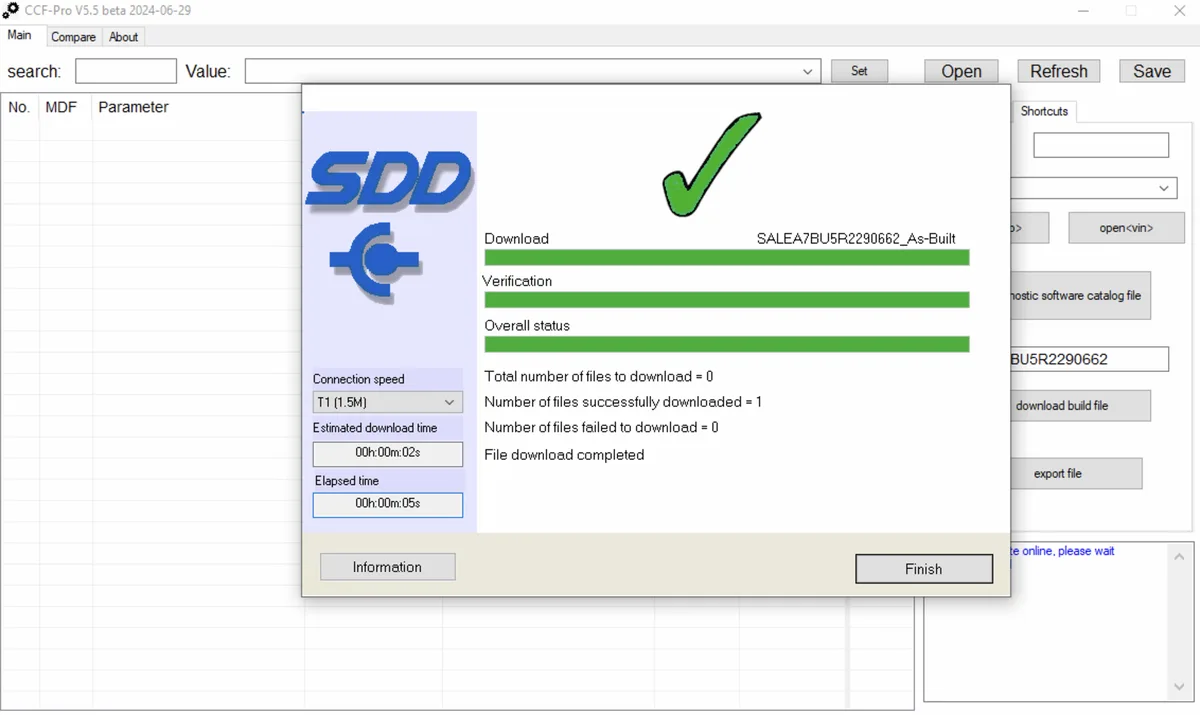
- Flash correct software. Run the "Replace ECU" routine so the module receives the correct, current software for the vehicle's VIN — a clean operating system regardless of the donor car's history.
- Write the VIN. In JET Master, use the ECM special functions to stamp the correct VIN onto the module, resolving the network mismatch.
- Immobilizer synchronization. Run the immo sync or ECM replacement wizard — the security alignment between ECM and KVM that dealer software withholds from used parts. This is the step that makes the engine start.
- Calibrations. Write injector codes on diesels and perform any required adaptations from the service functions menu.
- Verify. Clear all DTCs, cycle ignition, start the engine and test drive thoroughly before releasing the car.
Common Pitfalls in Used ECM Jobs
The failures in used ECM programming are almost always process failures — wrong donor part, skipped voltage support, or security steps attempted out of order — and every one of them is avoidable with a checklist mentality. The job punishes improvisation and rewards routine; treat the workflow as fixed procedure rather than a sequence to improvise on.
The pitfalls we see most:
- Approximate part matching. "Same engine" is not "same module" — confirm the exact part number or a documented supersession before money moves.
- Flashing on a weak battery. A voltage sag mid-flash can corrupt the donor ECM before it ever meets the car. The maintainer goes on first, always.
- Skipping the immobilizer sync. VIN writing alone does not make the engine start; the security alignment is a separate, mandatory step, and forgetting it produces a cranks-but-won't-start mystery.
- Missing calibrations. Injector codes on diesels and throttle adaptations are part of the job, not optional extras — skipping them shows up as rough running blamed on a "bad donor."
- No pre-work baseline. Capturing the full DTC state before you begin protects you when diagnosing any post-job surprises.
Follow the sequence, respect the voltage, and the job is repeatable rather than heroic.
The Business Case for Mastering This Job
A successful used-ECM programming job saves the customer thousands and weeks of waiting while generating one of the highest margins available to an independent workshop — capability here defines a true JLR specialist. Few single jobs change how a market sees a workshop as quickly as this one.
The customer maths: a used ECM at a fraction of the new-part price, a day's labour instead of a month of parts delay, and a total bill typically far below the dealer quote. The workshop maths: a job that competitors refer out stays in your bay, and the reputation that comes with solving "impossible" problems generates referrals money cannot buy. Where a module proves repairable rather than replaceable, our module repair service is the alternative route worth quoting first.
There is a capability compounding effect too: the workshop that masters ECM work finds the same toolchain and confidence carries straight into KVM, BCM and TCU jobs. Each module family has its quirks, but the discipline — verify the donor, stabilize the voltage, backup, write, synchronize, verify — is universal. Master the hardest module and the rest of the catalogue gets easier.
Frequently Asked Questions
What is the difference between ECM, ECU and PCM? In practice the terms overlap. ECU and ECM both mean the engine's main control computer; PCM (Powertrain Control Module) is a broader term that can include transmission control. In JLR contexts they refer to the same powertrain brain.
Can any used ECM be programmed to any vehicle? No. The part number must match or be a confirmed supersession, and the module must come from the same engine variant. Programming changes identity and software, not hardware capability.
Do I need to write injector codes after ECM replacement? On diesel engines, yes — each injector carries a unique calibration code that the ECM needs for smooth, efficient running. The function lives in the service routines of professional diagnostic tools.
Why won't Pathfinder alone do this job? Pathfinder is designed to program new, VIN-ordered modules. The security steps that adopt a used module — VIN rewriting on secured modules and immobilizer synchronization — sit outside dealer policy, which is exactly the gap engineering software fills.
How long does the full job take? With the correct donor module on hand, an experienced technician typically completes the flash, coding and synchronization in a single working day, including verification — versus weeks of lead time for a new VIN-ordered part.
Take On the Final Boss
ECM replacement separates specialists from generalists — and the workshops that master it never struggle for work, because the jobs everyone else refers out flow toward capability. SX-Tool provides the engineering software, the interfaces and — when you want backup — the remote expertise. Start at the JLR Pathfinder hub or sx-tool.com/en/shop/.