Buyer's Guide · Updated 2026
IIDTool vs SX-Tool — DIY Coder or Workshop Platform?
Two respected JLR tools built for two different users. What each genuinely does, where each stops, and how to decide which one your vehicles and workload actually need.
The Short Verdict
In the IIDTool vs SX-Tool decision the honest answer is that they are not competitors for the same job: the IIDTool is a capable DIY coding and diagnostics device for CAN-era vehicles, while SX-Tool is a workshop-grade diagnostic and engineering platform covering SDD, Pathfinder and TOPIx Cloud workflows on 2005–2026 vehicles.
Buy the IIDTool if you own one or two pre-2017 vehicles and want affordable coding and fault reading at home. Buy into the SX-Tool ecosystem if you work on JLR vehicles for money — especially anything from 2017 onwards, where DoIP support, online programming and engineering functions decide which jobs you can accept. The rest of this page breaks down exactly where the line sits.
What Each Tool Actually Is
Understanding the category difference prevents the most expensive buying mistake in JLR diagnostics — expecting a DIY device to do workshop work. The two tools come from different design philosophies:
GAP IIDTool — a Bluetooth dongle paired with a phone or tablet app. It reads and clears faults, shows live data and, its signature strength, exposes a menu of coding changes (CCF-style options) on supported CAN-era vehicles. It is genuinely good at what it is designed for: giving an enthusiast dealer-adjacent capability without a laptop or a dealer subscription.
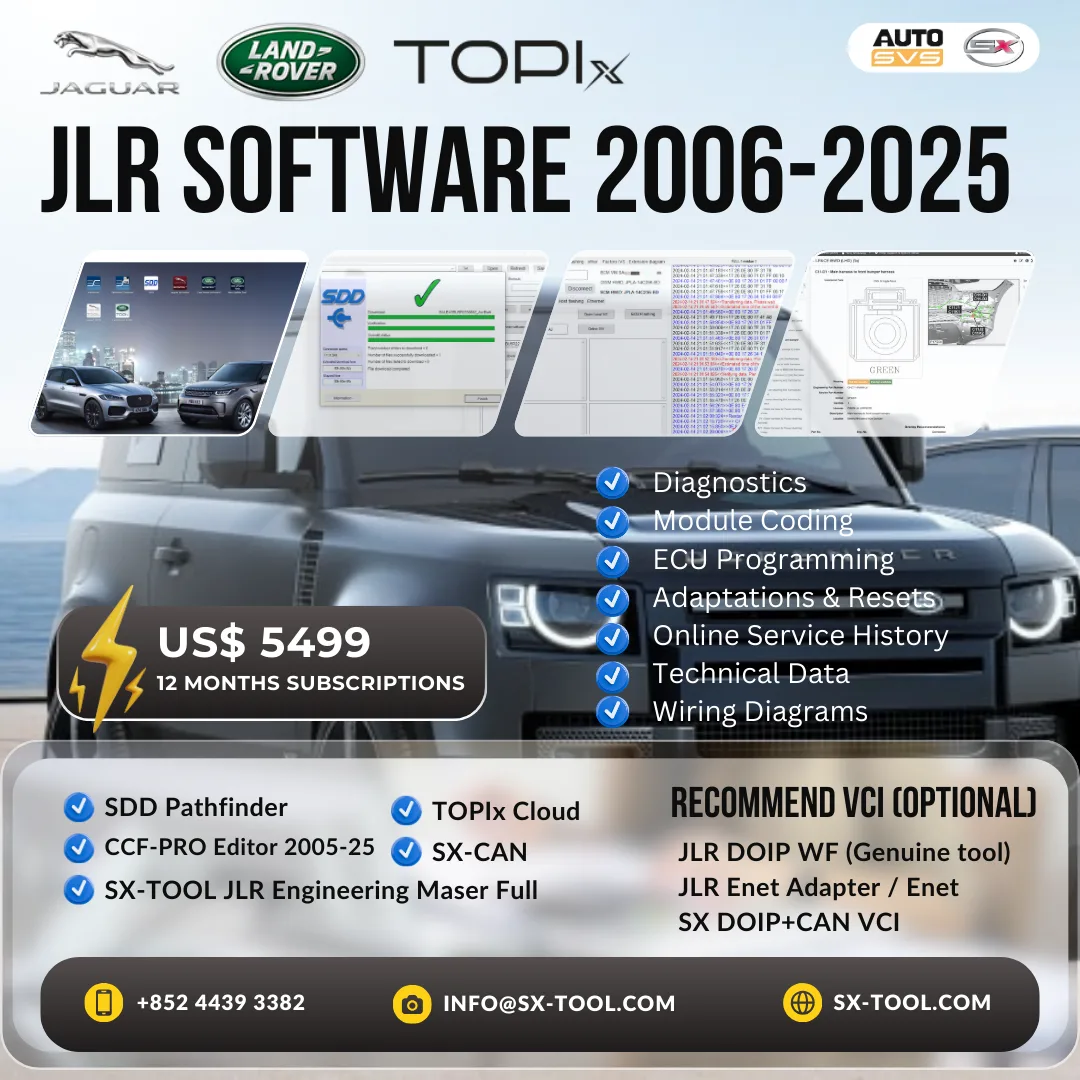
SX-Tool — a professional platform rather than a single gadget: the SX-Tool JLR diagnostic interface (native CAN + DoIP hardware with J2534 pass-thru), support for JLR's own SDD and Pathfinder software, TOPIx Cloud access for online work, and the JET engineering tool range for used-module, CCF and recovery work. It is what our own technicians use on customer cars daily.
Side-by-Side Specification
The specification table tells the story quickly — the IIDTool covers a capable slice of the CAN era, while SX-Tool covers the entire diagnostic timeline including the DoIP generation the IIDTool cannot reach:
| Capability | GAP IIDTool | SX-Tool Platform |
|---|---|---|
| Vehicle era | CAN-era focus (~2005–2017, model-dependent) | Full range: 2005–2026 |
| DoIP vehicles (2017+) | No | Yes — native DoIP + J2534 |
| Read / clear DTCs | Yes | Yes (all modules, guided) |
| Live data | Yes | Yes, with logging |
| Coding / CCF changes | DIY menu on supported models | Full CCF editing (SDD / Pathfinder / JET) |
| Module programming / flashing | No | Yes — offline and online via TOPIx Cloud |
| Key programming | No | Yes (with TOPIx Cloud / JET) |
| Used-module virginising | No | Yes — JET Master |
| Hardware form | Bluetooth dongle + app | Professional VCI + laptop |
| Support model | Community / vendor | Direct technical support + remote sessions |
Where the IIDTool Genuinely Wins
Credit where it is due — for a specific owner the IIDTool is the right purchase, and we say so despite selling the alternative. Its real strengths:
- Entry cost. A fraction of any professional setup; for a single-vehicle owner doing occasional coding it is unbeatable value.
- Simplicity. No laptop, no Windows environment, no software installation — the app walks you through changes in plain language.
- CAN-era coding depth. On supported models the coding menu is broader than most DIY tools: lighting behaviour, locking logic, convenience features and more.
- Community knowledge. Years of forum documentation mean most common changes already have a written walkthrough.
If your garage holds a Discovery 4 or an L322 Range Rover and your ambition is fault reading plus comfort-feature coding, stop here — the IIDTool is your tool, and our home scanner guide covers that world.
Where the IIDTool Stops — and Why It Matters
The ceiling arrives exactly where modern JLR work begins, and it arrives hard: the IIDTool has no DoIP capability. Everything from the 2017 generation onward — Defender L663, Velar, Evoque L551, Discovery 5 facelift, the MLA Range Rovers — communicates over Diagnostics over IP, which the hardware simply cannot speak.
Even within the CAN era, three walls matter for anyone doing paid work:
- No module programming. You cannot flash an ECU, replace a module and configure it, or apply software updates. Coding yes; programming no.
- No key or security work. Immobiliser and key operations are outside the tool's scope entirely.
- No engineering functions. Virginising a used KVM, cloning a BCM, recovering an interrupted flash — the profitable workshop jobs — need engineering tooling.
The pattern we see repeatedly: an enthusiast buys an IIDTool, enjoys it, then buys a 2018+ vehicle or starts helping friends for money — and hits all three walls in the first month. That is the moment the platform decision gets made, sometimes after paying for the same capability twice.
Cost of Ownership Compared
Sticker price alone misleads here because the two tools buy completely different futures — one caps your ceiling cheaply, the other converts spend into invoiceable capability. The honest comparison is total cost against the work each enables:
- IIDTool: low one-off cost, optional app upgrades by model or feature pack. Total spend stays low — but so does the ceiling of what you can charge or save.
- SX-Tool platform: a professional VCI as the foundation, then software to match your workload — free SDD for the CAN era, TOPIx Cloud access bought per day or per month for online work, JET tools when engineering jobs justify them. Higher entry, but every tier maps to invoiceable work: programming sessions, key jobs, used-module commissions and retrofit enablement.
For a business, the SX-Tool route is not a cost comparison against the IIDTool — it is a revenue decision. One used-module programming job that a dealer declines can return more than the price difference between the two tools.
Which Should You Buy?
Match the tool to the next twelve months of your reality — the vehicles you own or see, and whether money changes hands for the work — not to an aspirational workload you may never have:
- Single pre-2017 vehicle, DIY only, coding and fault reading → IIDTool. Genuinely the right choice.
- Mixed fleet or any 2017+ vehicle → SX-Tool interface. DoIP is non-negotiable from 2017.
- Charging for diagnostics or coding → SX-Tool. Customer vehicles demand programming stability and support.
- Module replacement, retrofits, keys → SX-Tool plus TOPIx Cloud access and, as volume grows, JET engineering tools.
- Not sure yet → Start with the interface and SDD; add online access per job through 1-day TOPIx Cloud passes so fixed costs stay near zero while you learn the demand.
Also consider the third path: for a single complex job, our remote coding service does the work with full professional tooling while you supply the connection — often cheaper than buying any tool for one repair.
Frequently Asked Questions
Can the IIDTool work on a 2018 or newer Land Rover? No — 2017-onwards JLR vehicles use DoIP communication, which the IIDTool hardware does not support. For those vehicles you need a DoIP-capable interface with Pathfinder and, for programming or keys, TOPIx Cloud access. The IIDTool remains excellent on the CAN-era fleet it was designed for.
Can the IIDTool program or flash JLR modules? No. It reads and clears faults, shows live data and applies coding changes on supported models, but it cannot flash firmware, program replacement modules or perform key coding. Those operations require workshop-grade tooling such as SDD, Pathfinder with TOPIx Cloud, or engineering tools.
Is SX-Tool too much tool for a home user? For one older vehicle used occasionally, often yes — which is why we recommend the IIDTool for that profile without hesitation. The calculation changes with a 2017+ vehicle, regular DIY across multiple cars, or any paid work, where the platform's coverage and support justify the step up.
What does SX-Tool do that Pathfinder alone does not? Pathfinder is JLR's diagnostic application; it needs a DoIP VCI to talk to the car and TOPIx Cloud for online operations. The SX-Tool platform supplies that hardware plus the engineering layer Pathfinder lacks: used-module virginising, advanced CCF editing and recovery from failed programming sessions.
Can I upgrade from an IIDTool to SX-Tool later without waste? Yes — they serve different eras, and many workshops keep an IIDTool-class device for quick CAN-era checks. Nothing about starting with the IIDTool blocks a later move; the only waste is buying a second DIY device instead of stepping up to the platform when the work demands it.
The Bottom Line
The IIDTool vs SX-Tool question resolves itself once you answer two others: do any of your vehicles date from 2017 or later, and do you charge for your work? Two "no" answers make the IIDTool a fine purchase. One "yes" makes the SX-Tool platform the only route that covers the vehicles and the jobs.
Browse the full SX-Tool range, read the wider JLR diagnostic tool comparison, or contact us with your vehicle list and we will tell you plainly which side of the line you sit on.
Last updated: 25 September 2026 · Written and reviewed by the SX-Tool technical team.
Last updated:
Ready to work like a dealer?
Order your SX-Tool interface today — worldwide shipping, 24-month warranty.
Visit the ShopGet the tools & parts
The hardware, software and services behind this guide — genuine SX-Tool products, worldwide shipping, 24-month warranty.
SX-DOIP | The Ultimate Universal JLR Diagnostic Interface
Introducing the SX-DOIP, the definitive diagnostic VCI for JLR professionals. Engineered to perfectly proxy…
US$999.00 View in the shop
JLR TOPIX Cloud Online Access
Dealer Portal Access for the JLR TOPIX Cloud. Must have for 2024-2025 JLR Vehicles. Unlock the full…
€95.04 View in the shop
Incontrol Touch Pro Map Update 2025 Africa, Middle East, Europe
Landrover Range Rover InControl Touch Pro Map Update 2025, Sat Nav Conversion Latest Maps the latest
US$159.00 View in the shop